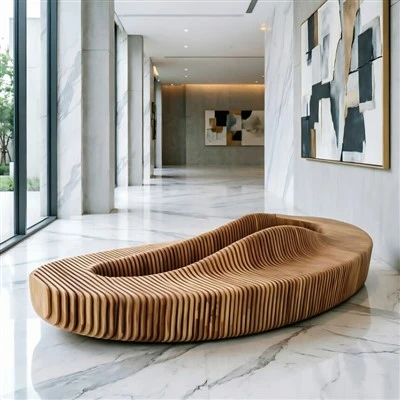
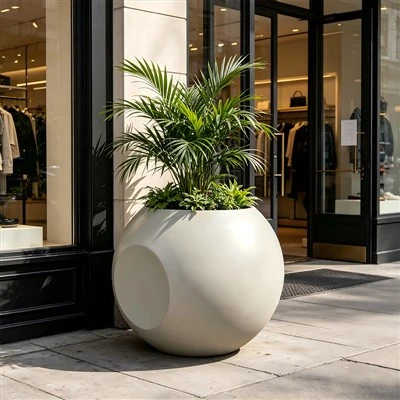
In the outdoor furniture, landscape engineering, public facility, and commercial decoration industries, fiberglass (FRP, Fiberglass Reinforced Plastic) and stainless steel are two of the most widely applied materials. Both materials have stable structural performance, outdoor durability, and decorative value, but they differ greatly in physical properties, production technology, appearance performance, cost, and application scenarios. Choosing the right material is crucial for product service life, maintenance cost, project budget, and overall aesthetic effect. This article will comprehensively analyze the core differences, advantages, and disadvantages of fiberglass and stainless steel, providing professional reference for commercial procurement, park landscape projects, and customized outdoor facility cooperation.
First of all, the essential material composition and molding principle of the two materials are completely different, which is the root cause of all performance differences. Fiberglass, commonly known as FRP, is a composite material composed of glass fiber as the reinforcing skeleton and resin as the bonding matrix. Through manual laying or mold compression molding, the material forms an integral solid structure after chemical curing. It belongs to thermosetting composite material, which cannot be melted and reshaped after molding. In contrast, stainless steel is a metal alloy material mainly composed of iron, chromium, and nickel. It is processed through integral cutting, welding, polishing, and bending. It maintains stable metal physical properties and can be secondary processed, repaired, and reshaped at any time. The fundamental difference in material structure determines their respective unique performance advantages and inherent defects in outdoor use.
In terms of outdoor weather resistance and environmental adaptability, fiberglass shows more outstanding comprehensive advantages. Fiberglass material has natural anti-corrosion, waterproof, and moisture-proof properties. It will not rust, oxidize, or deform in humid environments, coastal salt spray areas, or rainy and snowy weather. After professional UV anti-aging treatment, high-quality fiberglass products can effectively resist sunlight irradiation, slow down fading and powdering, and maintain stable appearance and structure for a long time in outdoor open-air environments. It is very suitable for outdoor parks, scenic spots, waterfront landscapes, and public leisure areas.
Stainless steel also has good anti-rust performance, but it has obvious limitations in complex outdoor environments. Although conventional 304 and 316 stainless steel can resist daily oxidation, they are still prone to surface oxidation, rust spots, and color fading in high-salt coastal areas and long-term humid environments. In addition, stainless steel is greatly affected by temperature. It will conduct heat rapidly under high-temperature sunlight, resulting in overheated surface that cannot be touched, and it is easy to produce condensation water on the surface in low-temperature and humid seasons, which increases subsequent maintenance cleaning work. In terms of long-term outdoor anti-aging ability, fiberglass is more adaptable and stable than stainless steel.
In terms of structural performance and bearing capacity, stainless steel has stronger rigid stability. Stainless steel has high hardness, strong compression resistance and impact resistance, and is not easy to deform or crack under strong external force. Its metal structural stability is far better than fiberglass, so it is often used in load-bearing facilities that require high structural safety, such as large landscape supports and heavy-duty public tables and chairs. However, the disadvantage of stainless steel is its poor toughness. It belongs to rigid metal material, which is easy to produce permanent deformation after violent impact, and the welding gap is easy to loose after long-term use.
Fiberglass has good toughness and integral flexibility. The overall molded structure has no welding gaps, and it will not loose or crack after long-term vibration and slight impact. Its bearing capacity can fully meet the daily use needs of outdoor furniture and public facilities. But its disadvantage is that the surface is relatively fragile compared with metal. Violent hard impact may cause local cracking or peeling of the resin layer, and the hardness is slightly lower than stainless steel. For conventional leisure tables, chairs, and landscape decorations, the structural strength of fiberglass is completely sufficient and more durable in daily use.
In terms of appearance, plasticity, and decorative effect, fiberglass has absolute advantages. Fiberglass adopts integral mold molding, which can realize various complex curved surfaces, special-shaped structures, artistic modeling, and integrated seamless molding. It can be made into various customized shapes according to project design requirements, with diverse styles and strong artistic sense. The surface can be made into matte, high-gloss, frosted, and various color spraying effects, with uniform color and strong overall integrity, which is very suitable for high-end art parks, scenic landscape decoration, and customized engineering projects.
The plasticity of stainless steel is relatively single. Limited by metal processing technology, it is difficult to make complex curved surfaces and irregular artistic shapes. Most stainless steel products are simple linear and conventional shapes, with a single decorative style. Although brushed, polished, and frosted metal surfaces have a unique industrial texture, they are difficult to match diverse art design styles, and the welding seams of finished products are obvious, which affects the overall aesthetic integrity of high-end landscape projects.
In terms of weight, transportation and installation cost, fiberglass is much more advantageous. Fiberglass is light in density, 30% to 50% lighter than stainless steel of the same volume. The lightweight feature greatly reduces transportation freight, loading and unloading difficulty, and on-site installation cost. It can be installed quickly without large-scale mechanical equipment, which effectively saves project time and labor costs. It is very suitable for large-area park renovation and batch engineering procurement.
Stainless steel has high density and heavy weight. Batch stainless steel products will produce high transportation costs, and require professional equipment and personnel for handling and installation. The overall project construction cost is higher, and the construction cycle is relatively longer. In addition, the heavy metal structure is easy to cause ground pressure damage in landscape areas, which increases the difficulty of on-site construction protection.
In terms of later maintenance and service life cost, fiberglass has lower comprehensive cost. The surface of fiberglass is smooth and dense, with no gaps and dead corners. It is not easy to accumulate dust, dirt and water stains, and is convenient for daily cleaning. Minor scratches and damage can be repaired locally with resin putty and spraying, with low maintenance cost and simple operation. The service life of high-quality fiberglass outdoor products can reach 8 to 15 years, which can meet the long-term use needs of public projects.
Stainless steel requires regular maintenance. The metal surface is easy to adhere to water stains, fingerprints, and dust, which need frequent cleaning and polishing to maintain brightness. Once rust spots and oxidation marks appear, professional polishing and anti-rust treatment are required, with high maintenance cost. Although the theoretical service life of stainless steel is long, the appearance aging speed in outdoor complex environment is faster, and the decorative effect will be greatly reduced after long-term use.
In terms of cost performance and batch production, fiberglass has obvious advantages in medium and low-budget large-scale projects. The raw material and processing cost of fiberglass is moderate, the mold can be reused for mass production, the production cycle is short, and the MOQ is flexible, which is very suitable for batch customized procurement of park furniture and landscape facilities. Stainless steel has high raw material cost and complex processing technology, resulting in high unit price of finished products, which is more suitable for high-budget projects with high structural safety requirements.
In conclusion, fiberglass and stainless steel have their own irreplaceable advantages and applicable scenarios. Fiberglass is lightweight, corrosion-resistant, highly plastic, low in maintenance cost, rich in artistic appearance, and cost-effective, which is the best choice for outdoor art parks, landscape decorations, leisure furniture, and large-batch municipal projects. Stainless steel has high hardness, strong bearing capacity and stable metal structure, which is more suitable for load-bearing structural facilities, high-strength equipment and simple-style outdoor engineering projects. In actual project cooperation, selecting materials according to project positioning, design style, budget and use environment can maximize product quality and project value.