Introduction: Why Material Choice Matters More Than Ever
In today's commercial environments, outdoor elements are no longer secondary considerations. Planters, seating, and landscape features play a central role in shaping how a space is perceived, used, and remembered.
For architects, landscape designers, and procurement teams, the challenge is no longer simply selecting a product-it is about choosing materials that align with design intent, construction efficiency, and long-term operational performance.
Among the available options, fiberglass planters are increasingly being specified not as an alternative, but as a strategic material solution within modern commercial projects.
Design Integration and Architectural Consistency
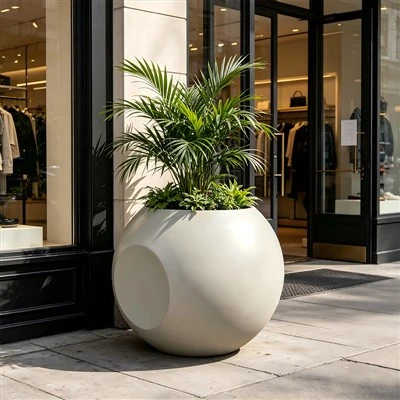
In contemporary commercial environments, consistency and identity play a defining role in how spaces are experienced. Rather than treating planters as isolated elements, designers are integrating them into a broader architectural language that reflects brand identity and spatial coherence.

The resulting finishes are clean and refined, supporting the high-end aesthetic increasingly expected in retail environments, hospitality projects, and mixed-use developments. In this context, fiberglass is not simply a material choice-it becomes part of the design strategy.
Case Insight: Reducing Installation Complexity Through Material Selection
Each unit was estimated to weigh several hundred kilograms, requiring cranes or lifting equipment for installation. Transportation costs increased due to the weight, and on-site adjustments were limited once the units were delivered.


After evaluating alternatives, the team transitioned to fiberglass. This shift reduced the overall weight by more than half, allowing for manual handling during installation and significantly lowering logistics complexity. At the same time, the design intent was preserved through custom molds that replicated the original geometry.
The outcome was not only a successful realization of the design concept, but also measurable improvements in installation efficiency, project timeline, and overall cost control.
A Lifecycle Perspective: Beyond Initial Cost
From a procurement standpoint, material decisions are often evaluated based on upfront pricing. However, in commercial projects, the total cost of ownership extends far beyond the initial purchase.
Fiberglass planters offer a different cost structure when viewed across the full project lifecycle. Their lightweight nature reduces transportation and installation expenses, while their durability minimizes maintenance and replacement frequency over time. Unlike metal, they do not corrode, and unlike certain stone or concrete applications, they are less prone to cracking under environmental stress.
This broader perspective is increasingly shaping how procurement teams evaluate materials, shifting the focus from unit price to long-term value and operational efficiency.

Material Comparison in Commercial Applications
To better understand where fiberglass fits within a material strategy, it is useful to compare its performance against commonly used alternatives:
| Criteria | Fiberglass Planters | Concrete Planters | Metal Planters |
|---|---|---|---|
| Weight | Lightweight, easy to transport and install | Very heavy, requires machinery | Moderate |
| Design Flexibility | High, supports complex and custom forms | Limited by casting constraints | Moderate |
| Installation Efficiency | Fast, labor-efficient | Time-consuming, equipment-dependent | Medium |
| Weather Resistance | Strong UV and corrosion resistance | Durable but may crack over time | May rust or overheat |
| Maintenance | Low | Low–medium | Medium–high |
| Lifecycle Cost | Optimized | Higher due to logistics and installation | Variable |
This comparison highlights a key point: fiberglass is not necessarily the lowest-cost material upfront, but it often delivers greater efficiency and predictability over the course of a project.
Multi-Functional Design Opportunities
Beyond its structural and logistical advantages, fiberglass also supports a more integrated approach to outdoor design. In many commercial environments, planters are no longer single-purpose elements but part of a broader system of spatial organization.
With fiberglass, planters can be designed to incorporate seating, define circulation paths, or function as subtle partitions within outdoor dining or public areas. They can also be integrated with lighting or signage, reducing the need for additional standalone elements and contributing to a cleaner, more cohesive environment.
This ability to combine functions within a single design element is particularly valuable in high-density commercial settings, where space optimization and visual clarity are both essential.
Where Fiberglass Creates the Most Value
While fiberglass is versatile, its advantages are most evident in projects that demand both design precision and operational efficiency. This includes large retail developments, hospitality environments, office campuses, and urban public spaces where consistency, durability, and ease of installation are critical.
It is also increasingly used in rooftop landscapes and elevated structures, where weight limitations make traditional materials less practical.
In these contexts, fiberglass is not simply a substitute-it becomes a preferred solution.
Conclusion: A Material That Aligns Design and Performance
Material selection in commercial projects is no longer a purely technical decision. It sits at the intersection of design, engineering, procurement, and long-term asset management.
Fiberglass planters stand out because they align these dimensions. They support design flexibility without introducing unnecessary complexity, enable efficient installation without compromising quality, and deliver long-term durability with minimal maintenance.
For teams seeking to balance creativity with practicality, fiberglass represents a material choice that is both forward-looking and grounded in real project needs.
If you are currently planning a commercial landscape or outdoor project, fiberglass planters may offer a more efficient and adaptable solution than traditional materials.
We support architects, designers, and procurement teams with custom fiberglass planter solutions, tailored to project specifications, installation requirements, and design intent.
Feel free to share your drawings or project requirements-we can help evaluate the most suitable approach.