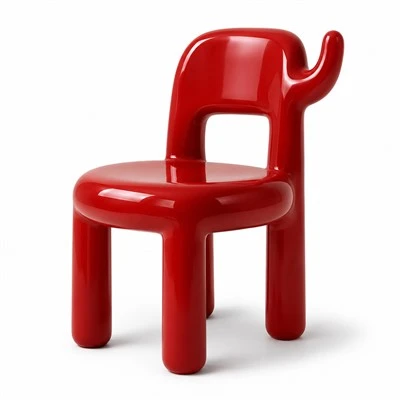
Choosing the right material is an important part of commercial furniture and custom product development. Different materials offer different advantages in appearance, structure, production methods, maintenance, and customization.
Fiberglass, wood, metal, and conventional plastics are all commonly used in furniture and commercial environments. Instead of asking which material is simply "better," buyers and designers should consider which material is most suitable for the design, application, production quantity, environment, and budget of a specific project.
This guide explains the characteristics of each material and compares their suitability for custom commercial furniture and decorative applications.
Common Materials Used in Commercial Furniture
1. Fiberglass / FRP

Fiberglass, commonly known as FRP (Fiber Reinforced Plastic), is a composite material made from glass fiber reinforcement combined with a polymer resin matrix.
The glass fibers provide strength and stiffness, while the resin binds the fibers together and helps protect the structure from the surrounding environment.
One of the main advantages of fiberglass is its ability to be molded into complex three-dimensional forms. With a properly designed mold, manufacturers can produce curved surfaces, integrated structures, organic shapes, and customized products that may be difficult to achieve with conventional fabrication methods.
Fiberglass surfaces can also be customized with different colors, textures, gloss levels, and coatings.
Typical applications include:Custom furniture,Benches and seating,Reception desks,Planters,Sculptures,Decorative installations,Themed furniture,Commercial display structures.Fiberglass is particularly useful for projects that require a strong visual identity or unusual product shape.
2. Wood
Wood remains one of the most widely used materials in furniture manufacturing.
Its natural grain, warm appearance, and workability make it suitable for residential, hospitality, retail, and commercial interiors. Different wood species also provide different levels of hardness, density, color, and durability.
Wood can be cut, carved, joined, laminated, painted, stained, or coated, allowing manufacturers to create both traditional and modern furniture.
Typical applications include:Tables,Chairs,Cabinets,Shelving,Wall panels,Hotel furniture,Restaurant furniture,Decorative interior elements
However, the performance of wood can vary considerably depending on the species, construction method, surface treatment, humidity, and maintenance conditions.
For outdoor or high-humidity environments, suitable material selection and protective finishing are particularly important.

3. Metal

Metal is widely used in furniture, architectural structures, and commercial installations because of its structural strength and fabrication versatility.
Common materials include steel, stainless steel, and aluminum. Each offers different characteristics.
Steel provides high structural strength and is commonly used for frames and load-bearing structures.
Stainless steel offers improved corrosion resistance and is frequently used in commercial, hospitality, and outdoor environments.
Aluminum is significantly lighter than steel and naturally forms a protective oxide layer, making it useful where reduced weight and corrosion resistance are important.
Metal can be cut, bent, welded, machined, polished, powder-coated, plated, or painted.
Typical applications include:Furniture frames,Tables and chairs,Outdoor furniture,Shelving systems,Architectural structures,Decorative installations,Commercial displays
For highly complex curved or organic shapes, however, metal fabrication may require additional bending, welding, forming, and finishing processes.
4. Conventional Plastics

Conventional plastics include a wide range of polymer materials used in furniture, components, and molded products.
Common materials include polypropylene (PP), polyethylene (PE), ABS, and other thermoplastics. Their properties vary depending on the polymer, additives, design, and manufacturing process.
Plastic products are often lightweight, moisture resistant, and suitable for efficient mass production.
Injection molding is particularly common for high-volume production because it can produce consistent parts quickly after the tooling has been completed.
Typical applications include:Plastic chairs,Outdoor furniture,Furniture components,Storage products,Decorative products,Children's furniture,High-volume consumer products
For highly customized low-volume projects, however, injection molding tooling can represent a significant initial cost.
Fiberglass vs Traditional Materials
After understanding the basic characteristics of each material, buyers can compare them according to specific project requirements.
|
Feature |
Fiberglass / FRP |
Wood |
Metal |
Conventional Plastic |
|
Design Flexibility |
Excellent for curved, organic, and complex molded shapes |
Excellent for many conventional furniture forms |
Highly versatile but complex curves may require additional fabrication |
Very suitable for molded shapes, especially in high-volume production |
|
Weight |
Generally offers a good strength-to-weight ratio |
Varies by species and construction |
Varies by alloy and thickness; steel is generally heavier than aluminum |
Generally lightweight |
|
Moisture Resistance |
Good when properly manufactured and finished |
Depends on wood species, coating, and maintenance |
Depends on material and protective finish |
Generally good |
|
Corrosion Resistance |
Does not rust |
Not applicable to rust, but moisture can affect performance |
Steel may require protection; stainless steel and aluminum perform better |
Does not rust |
|
Complex Custom Shapes |
Very suitable |
Possible, but complex forms may require additional machining or lamination |
Possible, but fabrication complexity may increase |
Excellent with suitable molds and production volume |
|
Low-Volume Customization |
Well suited to many custom projects |
Well suited to custom furniture |
Suitable, depending on fabrication complexity |
Tooling cost may be less economical for very low volumes |
|
Typical Applications |
Custom furniture, sculptures, planters, themed installations |
Furniture, cabinetry, interiors |
Structural furniture, frames, commercial fixtures |
Standardized furniture and molded products |
When Is Fiberglass a Suitable Choice?
Fiberglass is particularly suitable when a project requires a combination of customized shape, visual impact, relatively lightweight construction, and repeatable mold-based production.
For example, fiberglass may be useful for:
Curved commercial benches
Sculptural seating
Custom reception desks
Large decorative planters
Themed furniture
Shopping mall installations
Hotel decorative elements
Entertainment venue furniture
Branded commercial displays
Its molding capability allows multiple functions to be integrated into a single form, reducing the need for numerous visible joints.
However, fiberglass is not automatically the best material for every application.
For simple rectangular furniture, wood or metal may provide a more practical solution. For very
large standardized production runs, injection-molded plastics may offer manufacturing advantages.
Material selection should always reflect the specific needs of the project.
What Should Buyers Consider When Selecting a Material?
Several factors should be evaluated before choosing a material for custom furniture or commercial installations.
Design Requirements
Complex curves and organic shapes may favor fiberglass or molded plastics, while conventional furniture forms can often be produced efficiently in wood or metal.
Usage Environment
Indoor and outdoor environments place different demands on materials.
UV exposure, moisture, temperature changes, cleaning requirements, and installation conditions should all be considered.
Structural Requirements
Furniture and installations that carry significant loads may require structural reinforcement or additional engineering.
Material thickness alone should not be used as the only indicator of strength.
Production Quantity
Production volume affects manufacturing economics.
Mold-based production often becomes more efficient when multiple identical products are required, while some low-volume projects may be better suited to direct fabrication.
Surface Appearance
Each material offers a different visual character.
Wood provides natural texture, metal can create a clean architectural appearance, plastics offer consistent molded finishes, and fiberglass provides broad freedom in color, texture, and sculptural form.
Maintenance Requirements
Maintenance expectations should be considered throughout the product's service life.
The correct coating, surface treatment, and cleaning method can have a significant effect on long-term appearance and performance.
Is Fiberglass Better Than Wood, Metal, or Plastic?
There is no single material that is best for every commercial project.
Wood is often preferred for natural aesthetics and traditional furniture construction.
Metal is highly suitable when structural strength, thin profiles, or architectural appearance are important.
Plastic is effective for lightweight standardized products and large-volume molded production.
Fiberglass becomes especially valuable when a project requires:
Complex three-dimensional shapes
Custom dimensions
Integrated structures
Decorative surface finishes
Corrosion resistance
Repeatable mold-based production
The most appropriate material depends on design goals, structural needs, quantity, environment, maintenance expectations, and budget.
Conclusion
Fiberglass, wood, metal, and plastic each have their own role in modern furniture and commercial product manufacturing.
Fiberglass stands out mainly because of its ability to combine structural performance with significant freedom in shape and surface design. This makes it particularly useful for customized furniture, sculptural products, themed installations, and visually distinctive commercial environments.
Instead of selecting a material based on a single advantage, designers and buyers should evaluate the complete project requirements before making a decision.
Understanding the differences between these materials can help improve product design, manufacturing efficiency, long-term performance, and overall project results.