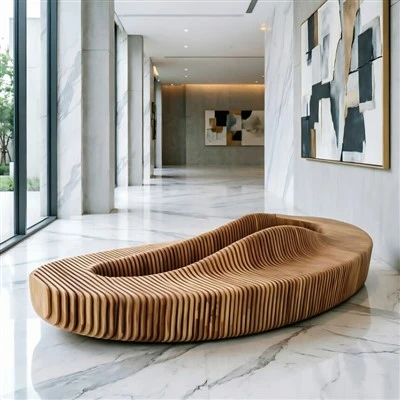
Have you ever noticed that two wooden slice wall panels of the same size can have drastically different prices, sometimes even double? What factors actually determine the cost and quality of parametric wood slice wall panels?
Parametric wood slice wall panels are not just decorative surfaces-they are precision-engineered wall elements, where each wooden slice is placed according to algorithmic design rules. They are widely used in commercial spaces, public buildings, and high-end residential interiors. Understanding the cost structure behind these panels is essential for designers, project managers, and homeowners who want to make informed purchasing decisions.
This guide breaks down the key factors affecting cost and quality, including design complexity, material choice, CNC fabrication, installation, and finishing, with real examples and actionable tips.
Understanding Design Complexity and Its Impact on Cost
Design complexity is one of the primary drivers of cost for parametric wood slice wall panels. Unlike standard wall panels, these panels are created using algorithmic design principles, which allow each slice to vary in thickness, curvature, angle, and spacing.


Number of Slices
The total number of slices directly impacts CNC cutting time and project labor costs.
Example: A wall measuring 5 meters long and 3 meters high with 20mm thick slices and 15mm spacing requires approximately 600 slices.
CNC cutting time for flat panels: 0.5 hours per slice → 300 hours.
CNC cutting time for complex wave-shaped panels: 0.8–1 hour per slice → 480–600 hours.
Cost implication: At an average CNC rate of $35–50 per hour, complex designs can add $6,300–15,000 compared to straight panels.
Curvature and Iteration
More complex curves require unique CNC programming for each slice and more design iterations:
High-end projects often require 3–5 design iterations, each potentially adding 5–10% to design costs.
Case example: A London office wave-shaped wall panel project (8 meters long, 3 meters high) took 3 weeks from concept to final CNC-ready files, while a straight panel took only 3 days.

Material Selection: Balancing Cost and Longevity
The type of wood significantly affects both cost and performance. Choosing the right material depends on project budget, location, and durability requirements.
Common Wood Materials
|
Material |
CNC Performance |
Cost per Slice |
Typical Use |
Durability |
|
Solid Wood (Oak, Walnut) |
Precise but slower cutting, requires careful sanding |
$25–30 |
High-end lobbies, feature walls |
Very durable, natural texture, susceptible to moisture without proper finishing |
|
Engineered Wood / Plywood |
Stable, easy to assemble, less prone to warping |
$12–15 |
Commercial partitions, public spaces |
Stable, moderate durability |
|
FSC-Certified Wood |
Same as solid wood, meets sustainability standards |
15–20% more expensive |
Public projects, international standards |
Environmentally certified, high durability |
- Thickness and density matter: 18–30mm thickness ensures structural stability.
- Example: In a Swedish commercial lobby, 18mm walnut slices were used for a wave feature wall. Cost per slice: $25–30. Using engineered plywood would have been $12–15 per slice but slightly lower long-term durability.
CNC Fabrication and Production Processes
Precision CNC cutting is critical for both quality and cost.
CNC Precision
- Public or commercial spaces often require ±0.5mm tolerance, while residential interiors can accept ±1mm.
- Higher precision increases cutting time by 10–20%, affecting labor and machine cost.
- Large panels without precise CNC can result in 10–15mm installation deviation.
Production Workflow
- CNC cutting
- Slice numbering
- Secondary sanding
- Edge finishing and sealing
Example: A New York high-end restaurant used 450 slices. Secondary sanding and finishing accounted for 25% of total cost, ensuring perfect flatness and surface quality.

Installation Methods and Long-Term Performance
The installation method can greatly affect both cost and the long-term stability of panels.
Installation Options
- Dowel + adhesive: Low cost, sufficient for small or light panels, but unsuitable for large or high-traffic areas.
- Hidden metal brackets: Higher cost (15–30% more), provides stability for large wall panels.
Modular Design Advantages
- Pre-numbered slices based on parametric design reduce onsite errors.
- Onsite adjustments for large panels cost $50–80 per hour.
- Example: A 7-meter wave-shaped wall in New York was installed in 2 days using a modular system, compared to 5 days without it. Labor cost savings: $3,000–4,000.
Surface Finishing and Maintenance
Proper finishing affects aesthetics, durability, and long-term cost.
Finishing Options
- Varnish: Retains natural wood color, moderate durability.
- Polyurethane (PU): Scratch and moisture resistant, adds ~20% more to cost.
Maintenance
- Public spaces: every 2–3 years, polishing or touch-up required
- Residential: every 5–7 years
Example: Dutch museum installed PU-coated slices. After 5 years, panels were still pristine, whereas varnished panels showed color changes and small cracks within 3 years, requiring additional maintenance.
Cost Breakdown Table
|
Cost Factor |
Specifics |
Price Impact |
Quality Impact |
|
Design Complexity |
Number of slices, curvature, iterations |
20–40% higher for complex designs |
Determines installation accuracy and visual effect |
|
Material Choice |
Solid wood, engineered wood, FSC-certified |
Solid wood 2–3x higher |
Affects durability and sustainability compliance |
|
CNC Fabrication |
±0.5mm vs ±1mm, secondary sanding |
10–20% higher for high precision |
Ensures flatness and fit |
|
Installation |
Dowel vs hidden bracket, modular design |
Brackets add 15–30% |
Ensures structural safety, reduces onsite adjustment |
|
Surface Finishing |
Varnish vs PU coating |
PU adds ~20% |
Affects wear resistance, moisture protection, longevity |
|
Project Scale |
Wall area, total slices |
Larger projects reduce unit cost but increase complexity |
Scale reduces per-piece cost but installation difficulty rises |
Conclusion and Buyer Recommendations
- Cost and quality of parametric wood slice wall panels depend on design complexity, material, CNC precision, installation, and surface finishing.
- B2B designers and project buyers: Evaluate wall size, curvature, slice quantity, and installation methods early to control budget and meet quality expectations.
- Consumers and DIY enthusiasts: Choose materials and finishing according to your space, aesthetic preference, and longevity requirements.
- Data references: Based on European and North American commercial projects, ISO 9001, FSC certification, and EN/ASTM public facility standards.
With this understanding, you can make informed decisions-balancing aesthetic vision, structural stability, and cost efficiency for any parametric wood slice wall panel project.