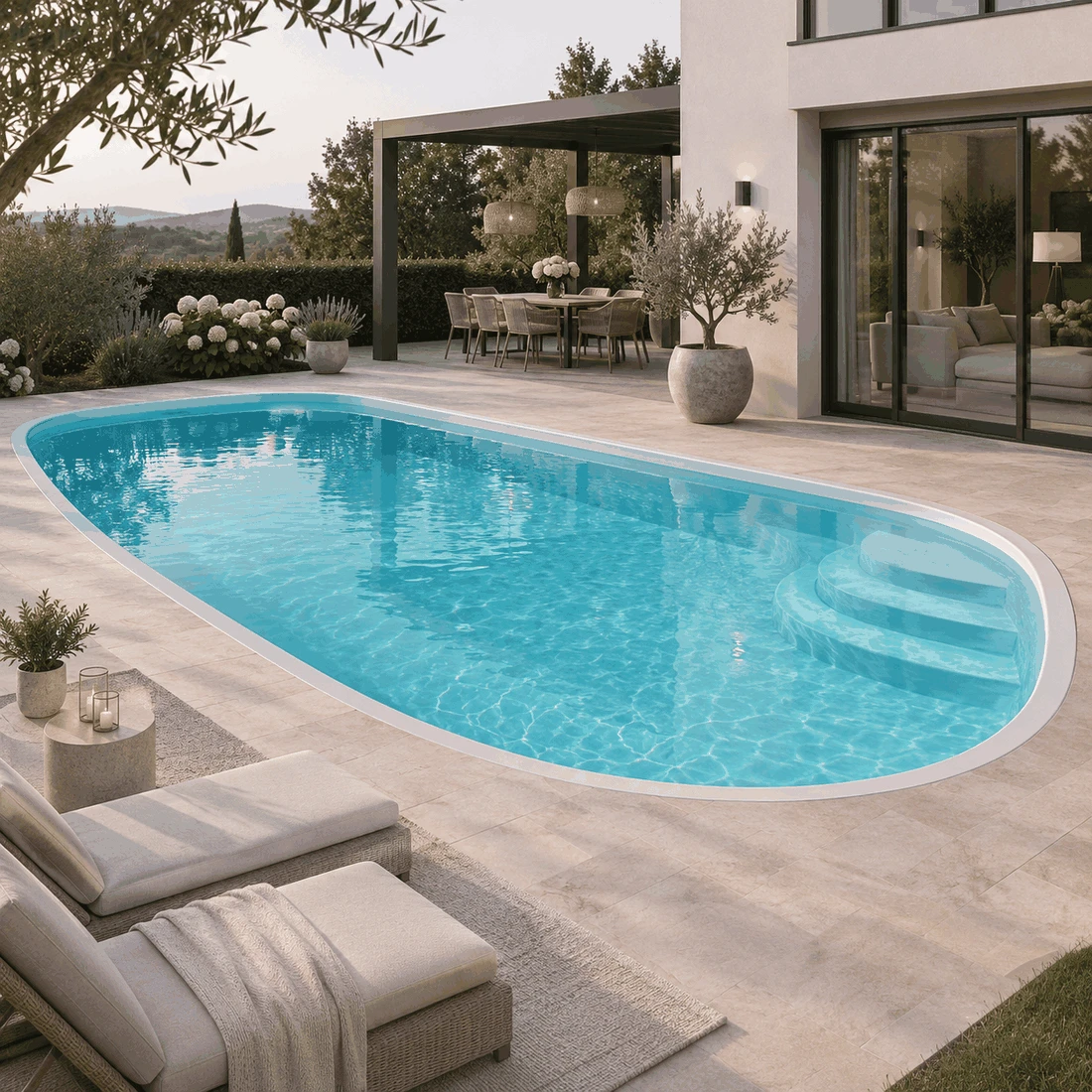
Fiberglass pools with built-in spas are becoming more visible in the 2026 residential pool market as homeowners look for backyard spaces that combine swimming, relaxation and wellness within a single design.
The change is not simply about adding a hot tub beside a swimming pool. New fiberglass pool designs are increasingly integrating the spa directly into the pool shell or overall layout, alongside features such as swim-up seating, tanning ledges, multiple entry points and compact footprints.
One of the clearest examples came from Latham, The Pool Company, which introduced several new fiberglass pool-and-spa designs at the 2026 NAHB International Builders' Show. The launch included the Axiom 12 Deluxe, Axiom 14 Deluxe and Bermuda 12 Deluxe, all featuring built-in spas as part of the pool design.
The product launches reflect a broader shift taking place across the pool and spa industry: homeowners increasingly want the backyard to function as a complete outdoor wellness and leisure environment rather than as a space containing a swimming pool alone.
Key Takeaways
Built-in spas are becoming a more important feature in new fiberglass pool designs.
Manufacturers are combining swimming, spa use and seating in increasingly compact footprints.
Fiberglass has grown to an estimated 22% of the U.S. residential inground pool market, according to an industry expert cited by AQUA Magazine.
Wellness, relaxation and year-round backyard use are influencing pool design decisions.
For manufacturers and buyers, integrated pool-and-spa products require more attention to mold design, plumbing, structure, transportation and installation than a conventional standalone fiberglass pool.
What Is Changing in Fiberglass Pool Design?
For many years, a swimming pool and a spa were often treated as separate backyard features.
A homeowner might install a pool first and add a hot tub somewhere nearby, or a concrete pool builder might construct a raised spa beside the main pool.
The current direction is becoming more integrated.
In February 2026, Latham introduced three new fiberglass pool models with built-in spas. The Axiom 12 Deluxe measures 12 by 26 feet, while the larger Axiom 14 Deluxe measures 14 by 30 feet. The Bermuda 12 Deluxe also measures 12 by 26 feet and combines a full-size swimming area with a built-in spa and swim-up seating.
These designs show how the spa is increasingly being planned as part of the pool from the beginning rather than added later.
That distinction matters because an integrated design can make better use of available space and create a more consistent visual relationship between the pool, spa, seating areas and surrounding landscape.
Why Are Pool-and-Spa Combinations Becoming More Attractive?
The strongest driver appears to be a change in how homeowners think about their backyards.
A swimming pool traditionally focuses on cooling, recreation and exercise. A spa provides a different experience based around warm water, relaxation and social use.
Combining the two allows the same backyard space to serve different purposes.
AQUA Magazine reported in September 2026 that spa design is increasingly being approached through the lens of wellness rather than water alone. One pool designer interviewed by the magazine said that it had become unusual for his recent residential designs not to include a spa.
Pool Magazine reported a similar shift in October. Its coverage of backyard wellness noted that homeowners are increasingly designing complete environments that bring together spas, swimming, landscaping, fitness, recovery and social spaces rather than treating each feature as an isolated purchase.
For fiberglass pool manufacturers, this creates a clear design opportunity.
Instead of offering only a shell for swimming, new designs can combine several experiences within the same molded structure or coordinated system.
Fiberglass Is Taking a Larger Share of the Inground Pool Market
The growing interest in integrated spa designs is taking place while fiberglass itself has become a more established part of the residential pool industry.
In an August 2026 AQUA Magazine article on the expansion of the fiberglass pool market, River Pools President Jason Hughes estimated that fiberglass represents approximately 22% of the residential inground pool market.
That figure should be understood as an industry estimate rather than an official government statistic, but it still illustrates how far fiberglass pools have moved beyond their earlier niche position.
Manufacturers and installers have increasingly emphasized benefits such as factory-controlled production, relatively fast installation and repeatable molded designs.
At the same time, fiberglass pool ranges have become more diverse.
Today's products can include tanning ledges, wading areas, swim-up seating, multiple entry points, compact plunge-pool layouts and, increasingly, built-in spas.
This wider feature set allows fiberglass pools to compete in projects that previously may have required more complicated site-built solutions.
Why Do Compact Pool-and-Spa Designs Matter?
Available backyard space is becoming an important design consideration.
Not every homeowner wants-or has room for-a large traditional swimming pool and a separate spa.
This helps explain why compact fiberglass designs are attracting attention alongside integrated spa models.
Latham also expanded its 2026 plunge pool range with two Milan models measuring 8 by 14 feet and 10 by 20 feet. The company described demand for plunge pools as part of a broader move toward resort-style experiences in smaller, more efficient footprints.
The same logic applies to fiberglass pools with built-in spas.
Combining swimming and spa functions within one coordinated footprint may be particularly attractive for smaller residential lots, urban properties and projects where the homeowner wants several features without allowing the pool area to dominate the entire backyard.
This does not mean every project should use an integrated design.
A separate spa may still offer greater flexibility in positioning, water temperature, equipment layout or future replacement. But the growth of integrated options gives designers and homeowners another way to work with limited space.
What Makes a Fiberglass Pool with a Spa More Complex to Manufacture?
From the outside, an integrated pool-and-spa design may look simple.
From a manufacturing perspective, however, it introduces additional considerations.
A conventional fiberglass pool shell already requires careful control of the mold, laminate structure, surface finish and overall dimensions.
Adding a built-in spa can create more complex geometry and additional transitions between seating areas, walls, steps and the pool body.
Manufacturers also need to consider how the spa will connect to plumbing and circulation equipment after installation.
Depending on the design, the project may involve:
Separate water circulation zones
Spa jets and plumbing penetrations
Integrated seating
Steps and access areas
Structural reinforcement around complex shapes
Equipment connections
Heating requirements
Transportation and lifting points
These requirements need to be considered early because fiberglass products are largely manufactured before arriving at the installation site.
That factory-built characteristic is one of fiberglass's advantages, but it also means the design, plumbing positions and structural details need to be defined accurately before production is completed.
Pool and Spa Integration Is Also Changing Backyard Appearance
Function is only part of the story.
Pool-and-spa combinations can also create a cleaner visual result because the two features share a consistent shape, color and material.
Latham's 2026 launch included new colors and finishes in blue, beige and grey tones, including sandstone- and marble-inspired patterns.
This reflects another important direction in residential outdoor design.
Homeowners are increasingly treating pools as part of the architecture and landscape rather than as isolated recreational equipment.
The pool shell, spa, paving, planting, outdoor furniture and surrounding structures are expected to work together visually.
An integrated fiberglass pool with spa fits naturally into this approach because the major aquatic elements can be designed as one composition.
How Does an Integrated Spa Affect Year-Round Use?
Another reason spas are becoming more important is that they can extend the usefulness of the backyard beyond the traditional swimming season.
A full swimming pool may be used most heavily during warmer months, while a heated spa can remain attractive during cooler weather.
This does not automatically make every integrated pool-and-spa system suitable for year-round operation. Climate, insulation, heating equipment, energy costs and winterization requirements still vary significantly by region.
However, the ability to offer both swimming and heated relaxation creates a broader use case than a pool alone.
That is consistent with the wider wellness trend currently influencing the pool industry.
The conversation is increasingly moving from "How large should the pool be?" toward "How often will the homeowner actually use the entire outdoor space?"
What Should Buyers Consider Before Choosing a Fiberglass Pool with a Spa?
An integrated design can look attractive, but buyers and project developers should evaluate the practical details before selecting a model.
| Project Question | Why It Matters |
|---|---|
| Pool and spa dimensions | Determines whether the system fits the available site |
| Spa seating capacity | Affects how the spa will actually be used |
| Water circulation | Pool and spa functions may require different operating conditions |
| Heating system | Spa temperatures require appropriate equipment and controls |
| Jet configuration | Influences the spa experience and plumbing design |
| Installation access | One-piece fiberglass shells require adequate transport and lifting access |
| Ground conditions | Site preparation affects the installation of the shell |
| Local regulations | Pool and spa safety, barriers, electrical systems and permitting vary by location |
The installation site should therefore be evaluated before final product selection.
A pool-and-spa shell that works well in one backyard may not be appropriate for another property because of access, ground conditions, equipment location or local construction requirements.
What Does This Mean for the Fiberglass Pool Industry?
The important development in 2026 is not simply that manufacturers are adding spas to more pools.
The bigger change is that fiberglass pool design is becoming more experience-oriented.
The industry is moving from relatively simple questions about pool shape and depth toward combinations of swimming, lounging, spa use, compact living and wellness.
This is happening while fiberglass continues to expand its position in the inground residential market. The estimated 22% market share cited by industry professionals suggests that buyers and installers are increasingly comfortable considering fiberglass for significant residential outdoor projects.
At the same time, manufacturers are responding with more complex products.
Built-in spas, tanning ledges, swim-up seating and compact plunge configurations show how the fiberglass pool is evolving from a standardized shell into a more complete backyard system.
Conclusion: The Fiberglass Pool with Spa Is Becoming a Complete Backyard System
The rise of fiberglass pools with built-in spas in 2026 reflects a wider change in residential outdoor living.
Homeowners increasingly want one space to provide swimming, relaxation, wellness and social use. Manufacturers are responding by integrating those functions more closely into the pool itself.
The introduction of new fiberglass pool-and-spa models, the continued growth of compact pool designs and the industry's increased focus on wellness all point in the same direction.
A fiberglass pool with spa is no longer simply a swimming pool with another feature attached to it.
It is increasingly being designed as one complete backyard system-combining recreation, warm-water relaxation and modern outdoor living within a single coordinated footprint.
FAQ
1. What is a fiberglass pool with a built-in spa?
A fiberglass pool with a built-in spa combines a swimming area and spa area within one coordinated fiberglass design. Depending on the model, the spa may include seating, jets and dedicated heating or circulation functions.
2. Can the pool and spa operate at different temperatures?
That depends on the hydraulic and equipment design. A true heated spa generally requires a system that allows the spa water to be heated and circulated appropriately. Buyers should confirm this with the manufacturer or installer rather than assuming every integrated design operates in the same way.
3. Are fiberglass pool-and-spa combinations suitable for small backyards?
Some models are specifically designed around compact footprints. For example, new 2026 fiberglass pool-and-spa products include designs around 12 by 26 feet. Site access, required setbacks and equipment space still need to be evaluated before selection.
4. Is an integrated spa better than a separate hot tub?
Neither option is universally better. Integrated spas can create a cleaner appearance and more unified pool area, while separate spas may offer greater flexibility in placement, replacement and operation. The correct choice depends on the project.
5. What information is needed before ordering a custom fiberglass pool with spa?
The buyer should confirm the overall dimensions, pool depth, spa size, seating arrangement, jet requirements, heating and circulation system, installation site, access conditions, finish, destination and local installation requirements.